

PROBLEM
Governing megacities is fraught with great difficulties
The number of urban villages in Baiyun District accounts for 1/6 of the city's total, and the daily household waste disposal volume makes up about 1/5 of the city's total. Its urban management faces a complex situation, a heavy workload and highly concentrated problems.
Sanitation fee collection at the town and sub-district levels is inconvenient, difficult to supervise, and non-uniform in standards. Moreover, no invoices are provided for the fees collected, resulting in major management loopholes and high collection difficulty.
The widespread phenomenon of garbage compression stations accepting and disposing of private waste has given rise to petty corruption at the grassroots level.
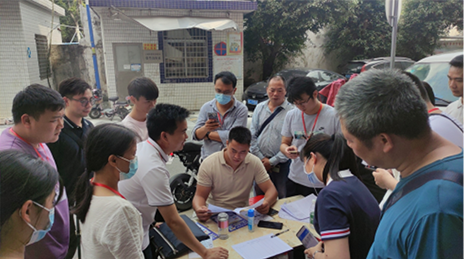
MEASURES
“1+4+N" Governance System
By comprehensively applying information technologies such as AI algorithms, IoT sensing and data analysis, we adhere to the principles of "planning guidance, source governance, supervision mechanism and data sharing", build the Baiyun Smart Urban Management System, form the "1+4+N" governance system, and create a new pattern of governance.
(1)Visualization of Management Components: More than 96,000 urban components and over 28,000 urban management supplies.
(2)Work Order Management for Daily Operations: Over 2.37 million work orders of various types have been generated, with a rectification rate of ≥ 99%.
(3)Online Attendance Management for Personnel: 259 socialized projects and over 9,000 service personnel.
(4)Diversification of Public Participation: WeChat Mini Programs such as "Suiyun Smart Urban Management" have been developed.
COMPARE
It has addressed the practical problems in urban management
(1)In terms of sanitation fee collection: After the transformation, the annual fee collection has reached over 450 million yuan, an increase of more than 130% compared with that before the transformation, with both the increment and the total volume ranking first in the city.
(2)In terms of garbage compression and disposal: The average daily garbage disposal volume has decreased by more than 300 tons compared with the same period last year, saving nearly 10 million yuan in fiscal funds annually.